The Engineering of Forgetfulness
Have you ever wondered why every app offers a "7-Day Free Trial" but requires a credit card upfront? It's not a convenience for you; it's a psychological trap designed by experts in behavioral economics. Companies know that once you sign up, several powerful cognitive biases kick in that make it remarkably difficult for you to cancel before the first charge hits. In this article, we'll dissect the "Trial-to-Subscription" pipeline and show you how to use Incinerator as your psychological shield.
1. Loss Aversion: The Pain of Letting Go
Humans are evolutionary hardwired to feel the pain of a loss twice as strongly as the joy of a gain. When you sign up for a trial, you gain a new "feature." By the 7th day, you've developed Psychological Ownership. Cancelling the trial feels like you are "losing" access to that tool, even if you haven't used it once. Companies exploit this by sending emails saying "Don't lose your access!" rather than "Ready to cancel?"
2. The Sunk Cost Fallacy and Cognitive Ease
The "Sunk Cost Fallacy" makes us want to continue an endeavor once we've invested time or effort. You spent 10 minutes setting up your profile and uploading a photo? Your brain now justifies the $15 charge because you "already did the work." Furthermore, humans naturally prefer Cognitive Ease—the path of least resistance. Cancelling a subscription often involves navigating through 5 screens, answering a survey, and sometimes even talking to a chatbot. Staying subscribed requires doing absolutely nothing. The companies win by default.
The "Forgot-to-Cancel" Disaster: A True Story
"I signed up for a premium fitness app's '30-day challenge' during a New Year's resolution phase. It was a $199 annual plan, but the first month was free. I did two workouts, got busy, and completely forgot about the app. Because it was an annual charge, I didn't see a monthly $15 ping on my statement. On February 1st, I was hit with a $199 charge. I contacted support, but they pointed to the fine print: 'No refunds after the trial period ends.' I paid $200 for two 15-minute workouts. I felt like an idiot, but really, I was just a victim of a very well-designed system."
Fighting Back: The Incinerator Defense Strategy
Incinerator is designed to break these psychological loops. Here is the technical procedure for "Trial Protection":
The "Trial Shield" Workflow
[ START TRIAL ] ──> [ ADD TO INCINERATOR ]
                         │
                         ▼
               [ SET RENEWAL DATE: 6 Days Out ]
                         │
                         ▼
               [ ACTIVATE "URGENT" BADGE ]
               (Visual cue to break Cognitive Ease)
                         │
                         ▼
               [ ONE-CLICK CANCEL LINK ]
               (Reduce friction to zero)
1. Immediate Logging: The moment you hit "Start Trial," you must add it to Incinerator. If you wait 24 hours, you've already lost.
2. Date Offsetting: Always set the billing day 24-48 hours before the actual charge. This gives you a buffer.
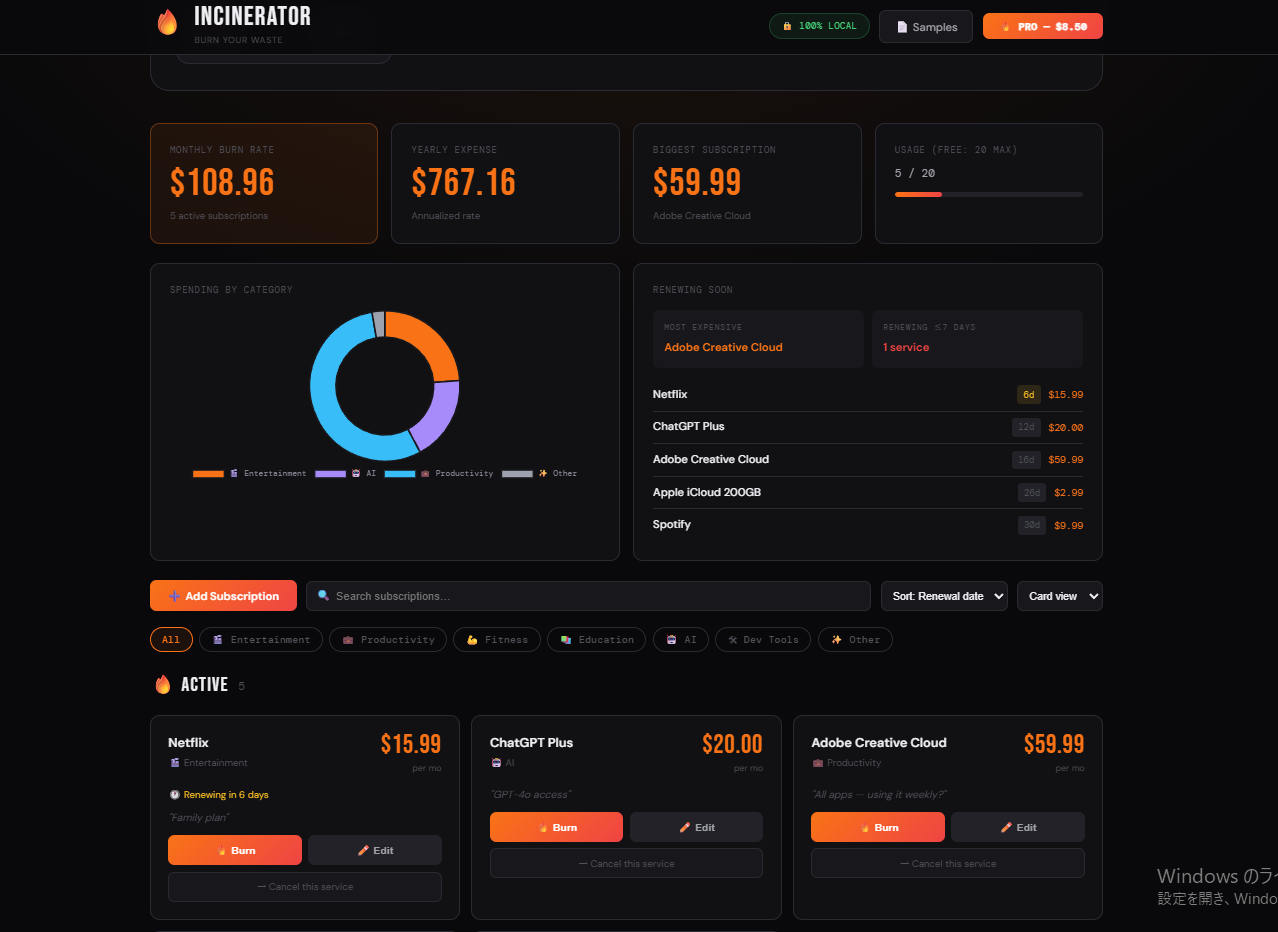
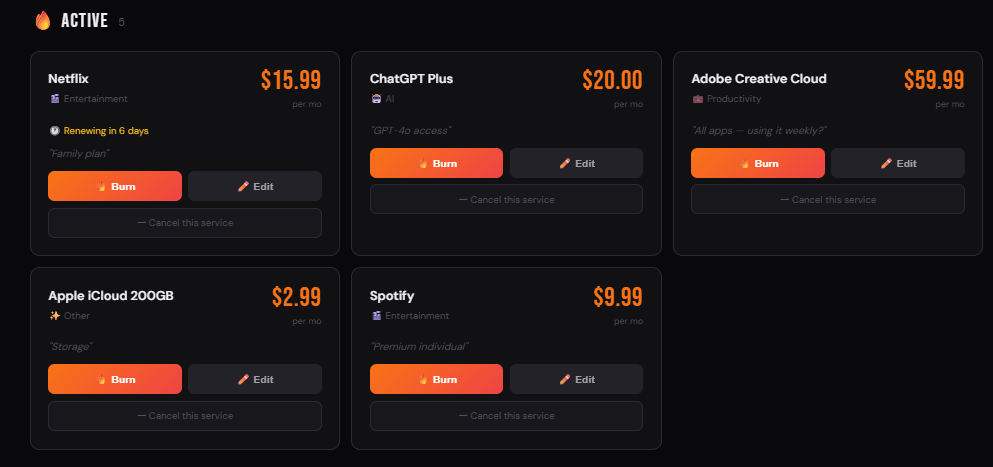
3. Visual Alerts: Incinerator's "Urgent" badge (orange glow) is designed to trigger a different part of your brain than the app's "Welcome" emails. It signals a financial event, not a feature gain.
4. Direct Action: Store the cancellation URL in the "Notes" field. When the badge turns orange, you are one click away from safety.
Future Self Benefit: Mental Clarity and Financial Sovereignty
The benefit to your future self is Mental Clarity. When you have a list of all your trials and subscriptions in one private place, you remove the "Background Anxiety" of wondering if you're being charged for something you forgot. You are in control of your financial destiny. Your future self will be richer, yes, but they will also be calmer. They will have a relationship with money that is active and intentional, rather than passive and fearful. Privacy-first tracking is the first step toward a more mindful digital life. Don't let the algorithms win—incinerate the trap.