The Rise of the "Five Dollar" Trap
We are living in the golden age of the subscription. From streaming services and gym memberships to productivity tools and "pro" versions of weather apps, everything is being packaged into a recurring monthly fee. Companies have discovered a powerful psychological secret: people are far more likely to agree to $5 a month than $60 a year, even though the total cost is identical. This is the Micro-SaaS Trap. It feels negligible on the day of purchase, but it becomes a permanent line item on your balance sheet that quietly eats away at your wealth.
The average professional today subscribes to between 12 and 20 different services. At an average of $15 per service, that's $180 to $300 a month—up to $3,600 a year. Over a decade, that's $36,000 of post-tax income gone. This is not just a "latte factor" problem; this is a systematic drainage of capital. In this guide, we will explore how to perform a deep-tissue audit of your digital life using the Incinerator methodology.
The "Zombie Subscription" Case Study
Consider the story of Mark, a freelance designer. Mark signed up for a stock photo site ($29/mo), a project management tool ($12/mo), a premium font service ($10/mo), and an AI writing assistant ($20/mo) for a specific client project that lasted three months. When the project ended, Mark moved on to his next gig. He stopped using the tools, but he never cancelled the subscriptions.
"I figured I might need them again soon. Six months later, I realized I hadn't logged into the photo site once. I had paid $174 for absolutely nothing. When I checked my credit card statement, I found three other 'Zombie' subscriptions I had completely forgotten about—an old VPN, a gaming pass, and a cloud storage upgrade I didn't need. Total waste: $480 in half a year. That's a plane ticket I just threw into the incinerator."
Mark's story is not unique. It's the standard. We call these Zombie Subscriptions—services that are technically active but functionally dead. They survive on your inattention.
How to Use Incinerator for a Professional Audit
The 4-Step Incineration Procedure
- The Grand Export: Open your banking app and search for "Recurring" or "Subscription." Export the last 90 days. Don't look at just one month—some subscriptions are quarterly or annual.
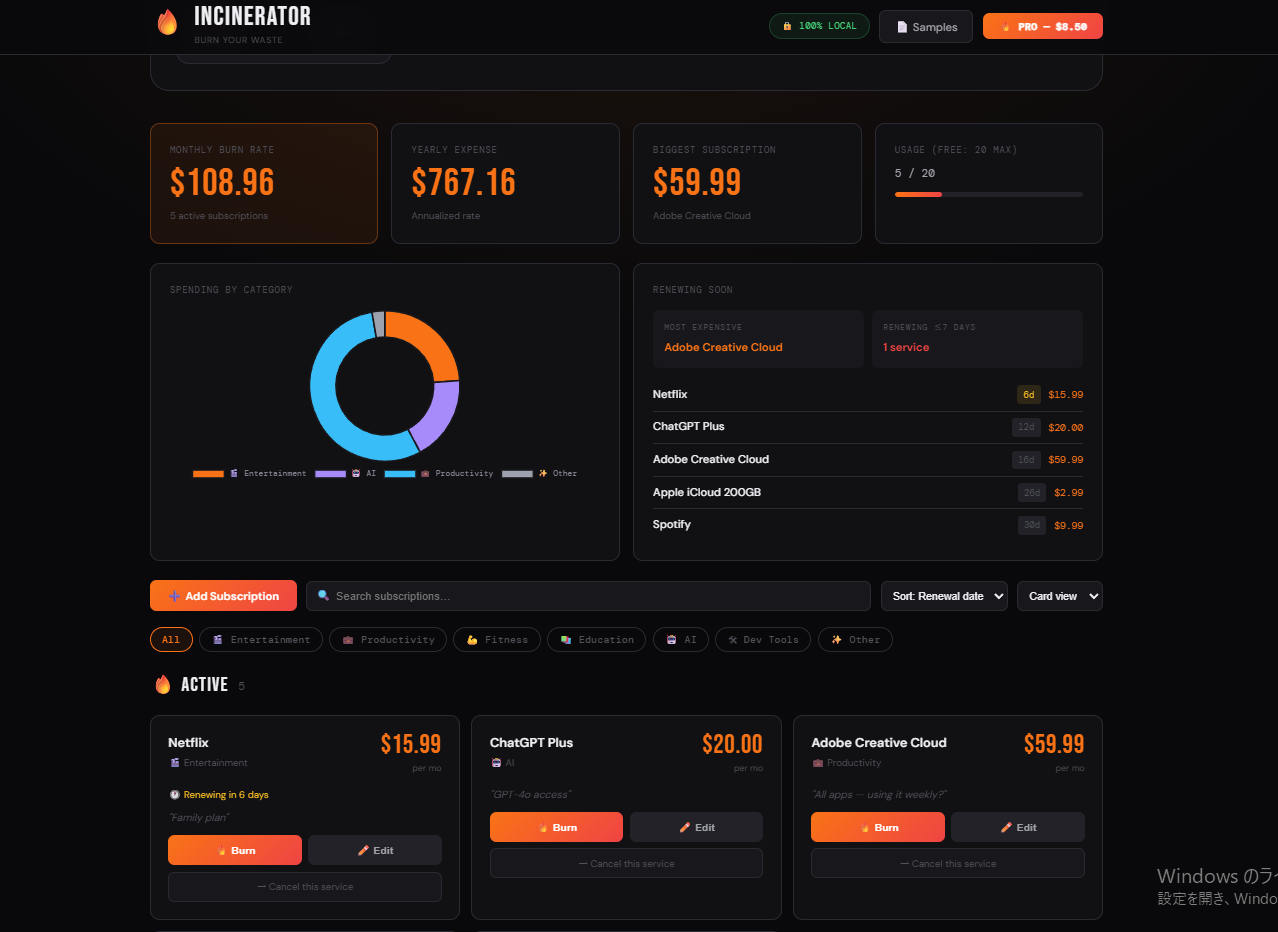
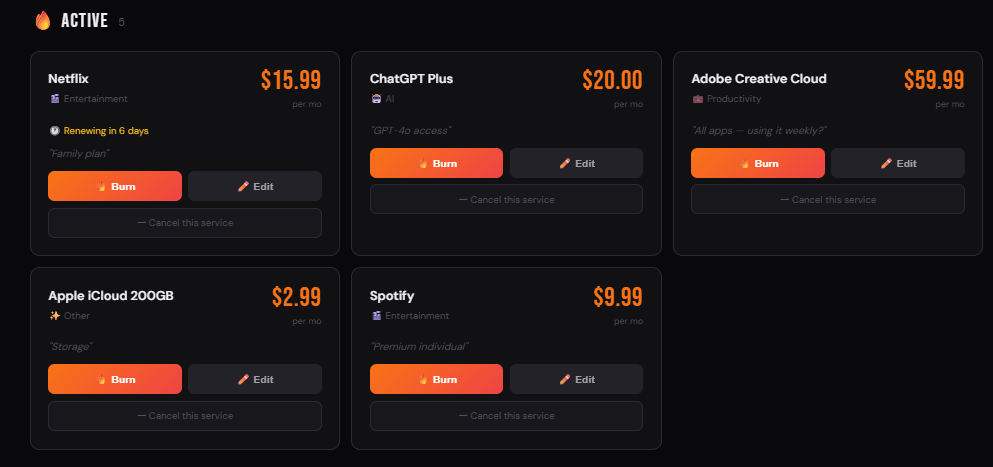
- The Preset Load: Open Incinerator and use our "Quick-Start Presets" for common services like Netflix, Adobe, or ChatGPT. This populates your dashboard with accurate pricing and logos instantly.
- The Binary Filter: For every item, ask the "Binary Question": Have I derived more value from this than its cost in the last 30 days? If the answer is "I don't know" or "Maybe next month," it's a candidate for incineration.
- The Burn Event: Use the "Burn" button in Incinerator to move wasteful items to your history. Incinerator will provide the direct cancellation link if available. Seeing the "Total Saved" number grow is the dopamine hit you need to stay disciplined.
The Future of Personal Finance: Local-First Auditing
Most finance apps want you to connect your bank account via Plaid. They want to store your transaction history on their servers and sell your "anonymized" data to advertisers. Incinerator is different. Because we use a Local-First architecture, your audit remains your business. Your "Burn List" is stored in your browser's IndexedDB. This privacy isn't just a feature; it's the foundation of trust. When you audit your waste, you shouldn't have to create more data waste on a cloud server.
The "Future Self" Perspective: Reclaiming Your Freedom
The benefit to your future self is Capital Aggregation. By cutting $100 of wasteful subscriptions today, you are giving your future self $1,200 a year. In a high-yield savings account or an index fund, that $100/month becomes $15,000 over 10 years. You aren't just "cancelling Netflix"; you are buying your future freedom. Your future self will look back at your Incinerator logs and see the day you decided to stop being a passive consumer and started being an active capital allocator. Start your audit today—burn the waste, keep the wealth.